Start with the assessment itself.
The real unit of value was never a platform, it was a good assessment. So we began there: what does it take to understand a designer properly in one sitting?
For over a decade I have designed inside big teams and hosted the leaders who hire designers. From both seats I kept seeing the same quiet waste: everyone re-proving the same thing, over and over.
Designers repeat their story for every role. Hiring managers re-screen from scratch every time. The same effort, spent again and again, just to reach the same trust from zero.
So I set out to build one central repository. One place that ends the repeating for designers, and the assessment guesswork for hiring managers.
The gap was clear. The harder question was how to close it without cutting corners.
The real unit of value was never a platform, it was a good assessment. So we began there: what does it take to understand a designer properly in one sitting?
We ran the first assessments manually, end to end. Doing it by hand taught us the real touchpoints and exactly what was worth keeping, before automating a thing.
Once the process was solid, we leaned on AI for the parts a system does better than a person: structuring sessions and turning long conversations into something usable.
We built a rigorous, repeatable scoring line that reads the transcript itself and names strengths, gaps, and where more evidence would have helped. Judgement, made consistent.
Every assessment produces media and data points. We keep them in a tidy, structured repository so a profile is searchable and ready for a hiring manager.
A scalable backend in Java and a React front end, so the product can grow without buckling under its own weight later on.
Hiring teams request access and fill a short form to get in. Consent and access control stayed the top priority, so every other door stayed shut until that was right.
A payment flow and a content system to manage everything across the product, so it keeps running and updating without a code change each time.
One assessment captures who a designer is, the work they have done, and how they think, then turns it into something searchable.
Who they are and how they frame themselves and their work, in their own words.
The real decisions behind real work, not just the polished final screens.
A live, unseen prompt, so we see how they actually think and move in the moment.
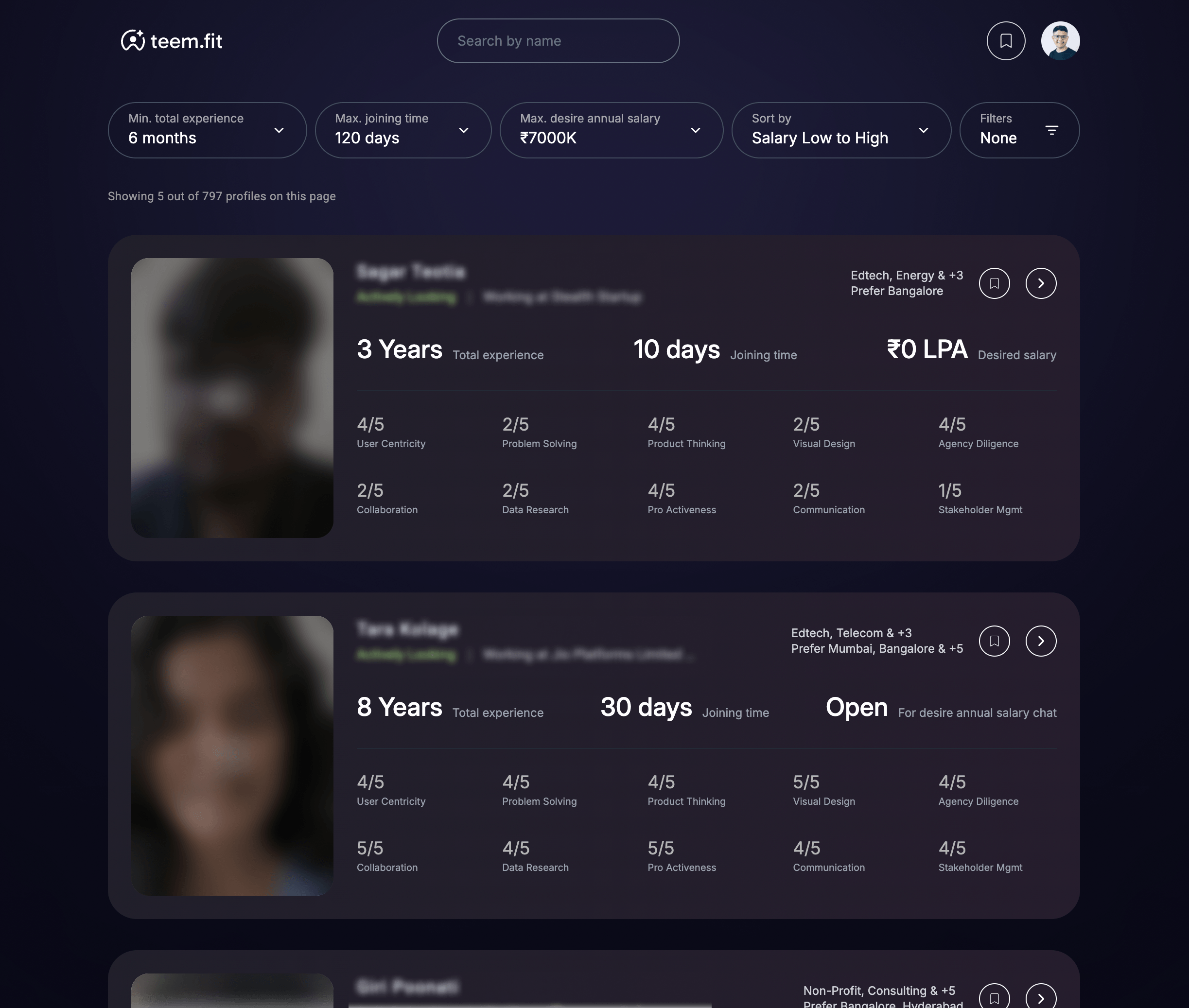
It all becomes a ranked repository a hiring manager can search and filter.
Leverage of AI
Every assessment produces raw media. AI shapes it into exactly what our system understands and needs, per designer and per assessment, so nothing gets prepped by hand.
Early on we changed the UI relentlessly, shipping and discarding, until the offering felt clear and seamless. AI let us prototype and iterate far faster than a small team otherwise could.
The same goal, a very different path. Here they are side by side.
Traditional way
Teem.fit way
The story we scripted and produced, about the loop we are trying to end.
Find the right designer fast, from a ranked, pre-vetted repository.
20+ teams onboarded

An AI feedback report after each assessment: strengths, gaps, and what would help, in 2 to 3 days.
1,000+ designers onboarded